
Seasoning as living heritage.
ไทย
Thai
เจ
Jay · Vegan
The spirit of the festival.
ลาบ
LAAB
earth
Cooking blend
Toasted rice powder
Chili flake
Galangal
Makrut lime
Mint
Gulf sea salt
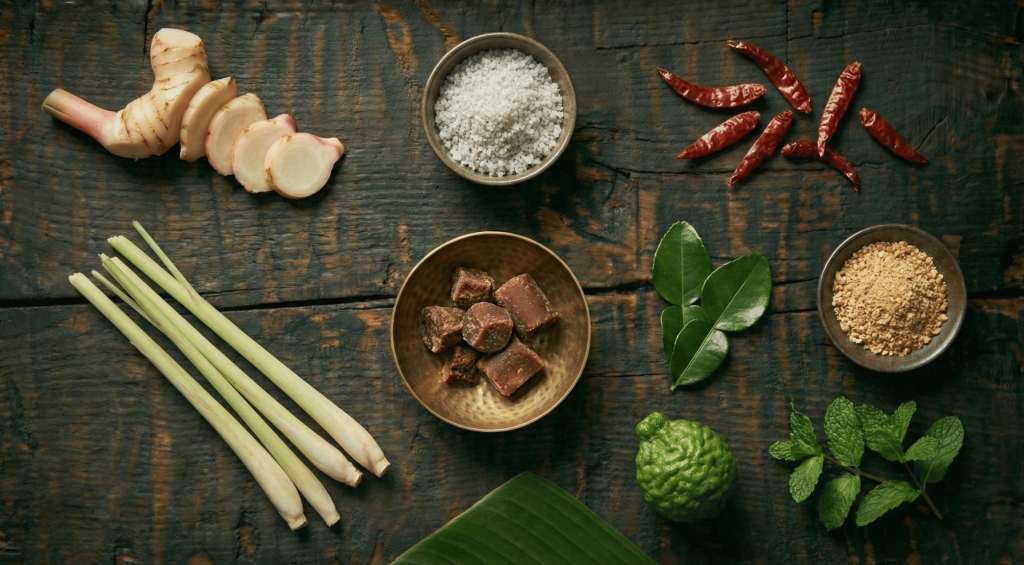
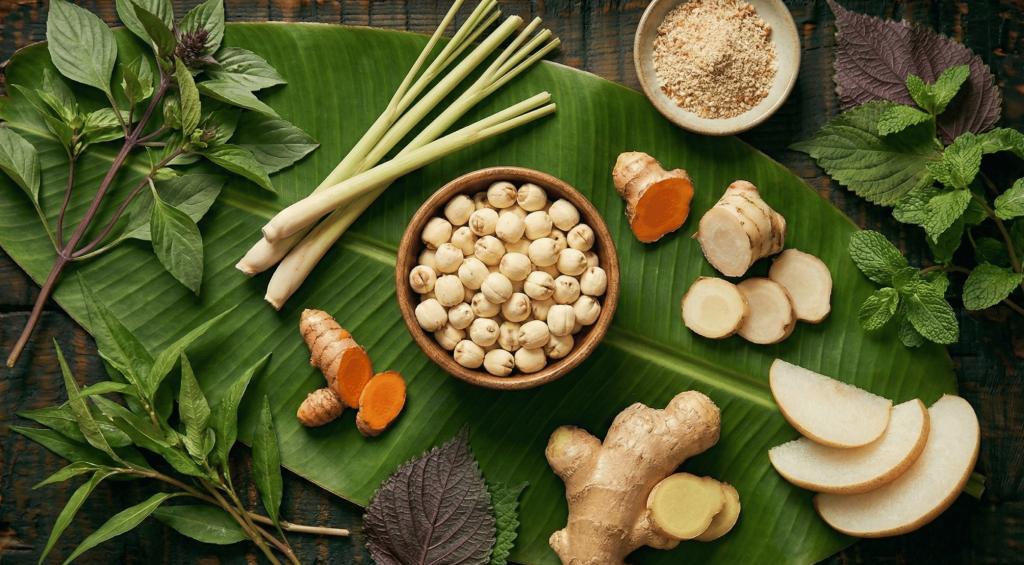
In Isan temple kitchens, laab begins with the wok. Long-grain sticky rice toasted over dry heat until it smells like a warm field, then ground. That powder is the foundation: it binds, carries heat, adds a roasted depth that nothing else does. Chili, galangal, makrut lime, mint built around it. You add the lime at the end. Laab, chopped mushroom salads, grain bowls.
Year-round
$14 · 50g
ถั่วเน่า
THUA NAO
ferment
Aromatic blend
Thua nao (sun-dried fermented soybean)
Makhwaen
Kaffir lime
Turmeric
Dried lemongrass
In the north, in Lanna and Mae Hong Son, thua nao is what shrimp paste is to the south. Soybeans fermented, pressed into discs, sun-dried for months in the dry-season heat. Buddhist cooks have built broths from it for centuries, no fish or allium needed. One teaspoon into hot water becomes a broth. Toast in oil first, then add coconut milk. Soups, curries, noodles.
Year-round
$18 · 60g
日
Japanese
精
Sei · Essence
Attention to every ingredient.
精進
SHŌJIN
essence
Foundational blend
Kombu
Shiitake
Okinawa sea salt
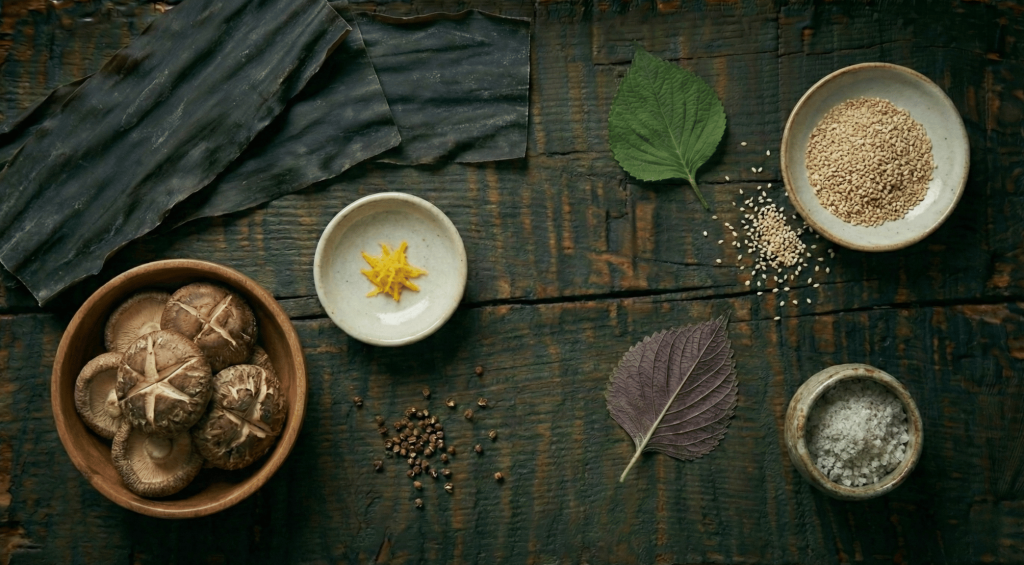
Shōjin dashi has been made the same way in Japanese Buddhist temple kitchens for centuries: kombu and shiitake, nothing added, nothing removed. The glutamate in kombu and the guanylate in shiitake together produce an umami intensity eight times greater than either alone. This is that, dried to powder. One scoop, hot water, done. Miso soup, simmered vegetables, noodle broth, rice.
Year-round
$26 · 80g
香り
KAORI
fragrance
Finishing blend
Yuzu zest
Shiso
Sansho
Okinawa sea salt
Yuzu is harvested once in autumn, cold air and full color, the citrus Japanese temple cooks have used for centuries. Shiso through summer. Sansho in spring. Each freeze-dried at peak, combined here. Three aromatics that arrive in sequence: yuzu’s brightness first, then shiso’s anise warmth, then the slow tingle of sansho at the finish. A pinch between thumb and forefinger. Chilled tofu, pickles, rice, grilled vegetables.
Autumn · Winter
$26 · 30g
燻
KUN
smoke
Finishing blend
Iburigakko
Yuzu kosho
Nori
Okinawa sea salt
In Akita, where winter makes sun-drying impossible, daikon is hung over cherry and oak fires for weeks, then buried in rice bran to ferment. Iburigakko: two transformations before it reaches this jar. Ground fine with yuzu kosho and nori. Smoke arrives first, then the sharp acid of yuzu kosho, then brine from the ocean, then a long savory finish. A pinch on eggs, rice, ramen, grilled tofu.
Autumn · Winter
$32 · 35g
中
Chinese
素
Sù · Simplicity
Purity in every grain.
麻辣
MÁLÀ
numb
Cooking blend
Pixian doubanjiang (3-year fermented)
Erjingtiao chili
Sichuan peppercorn
Dried citrus
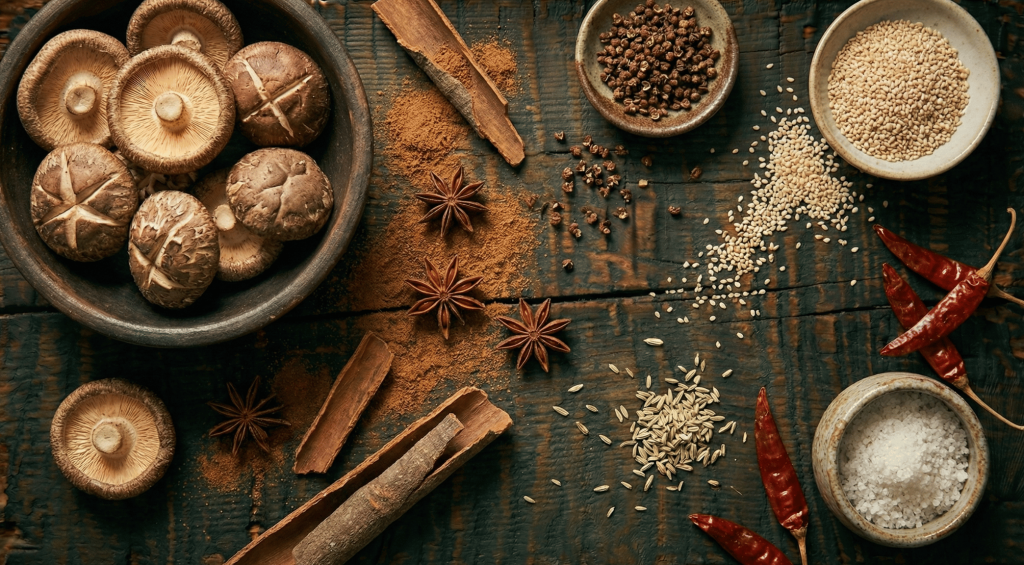
Pixian doubanjiang is made in one district in Sichuan, Pidu, turned by hand through four seasons, three years minimum in the jar. Geographic designation protects it: this paste cannot be legally produced anywhere else on earth. Combined here with erjingtiao chili and Sichuan peppercorn, dried down. Numb first, then warm, then deep. The foundation for mapo tofu, braises, noodles.
Year-round
$18 · 80g
椿
CHŪN
spring
Table blend
Toona sinensis (spring harvest)
White sesame
Shiitake
Roasted barley
Toon shoots appear for six weeks each spring and nowhere else in the year. Chan Buddhist cooks have used them for centuries. The one plant outside the allium family that carries the same sulfur note as garlic. Harvested, blanched, dried at peak. Open the jar and it smells like a kitchen with garlic in it. There is no garlic. Noodles, rice, tofu, dipping sauce.
Spring
$28 · 50g
韓
Korean
비움
Bi-um · Emptying
Nature, humanity, and the patience of fermentation.
고요
GOYO
stillness
Finishing blend
Wild pine mushroom
Roasted perilla seed
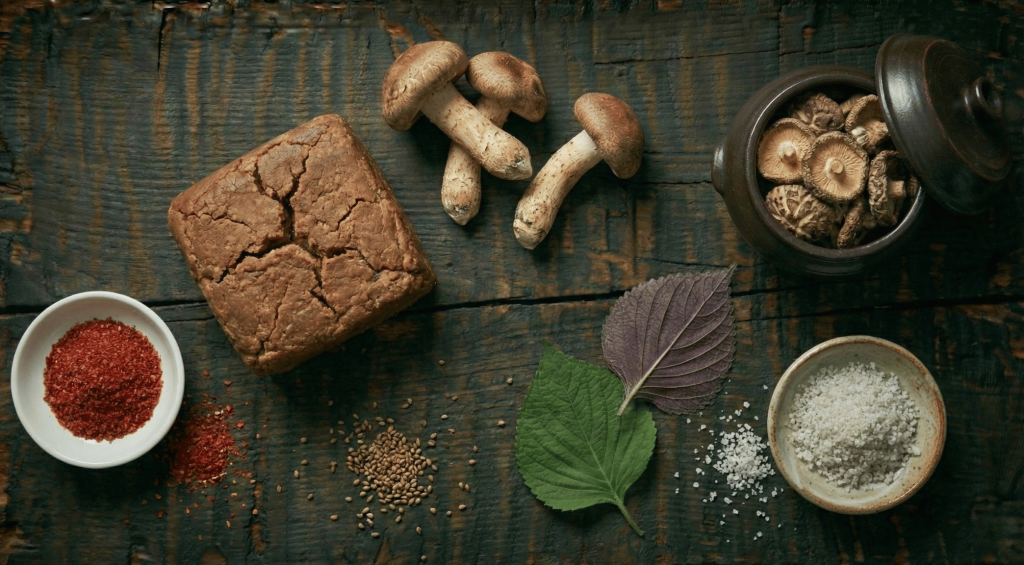
Two ingredients, nothing else. Wild pine mushrooms from Korean mountain forests, roasted perilla seeds, both prized in temple cooking for centuries. No salt. You decide. A single shake over hot rice, porridge, clear soups.
Autumn · Winter
$32 · 40g
Seasonal release. Wild-harvested pine mushroom availability varies.
장
JANG
ferment
Chili crisp
Doenjang (3-year fermented)
Gochugaru
Perilla seed
Toasted grain
Sesame
Korean temple kitchens age doenjang in onggi jars for three years before it is used. Mountain air, ceramic, time. This is that base, rendered into a crisp with gochugaru and perilla seed. There is one note you will not place. That is the perilla. On rice, noodles, eggs, tofu, anything.
Year-round
$14 · 100ml
시간
SIGAN
time
Finishing blend
Aged doenjang (3+ years)
Shiitake
Roasted sesame
Shinan sea salt
In Korean temples, doenjang is made once a year and left alone. Onggi jar, mountain air, three years untouched. Time does what hands cannot. Dried to powder here. A quarter teaspoon into plain rice and it becomes a meal. Tofu, vegetables, soup, rice.
Year-round
$38 · 60g
산채
SANCHAE
forage
Cooking blend
Fernbrake (gosari)
Bellflower root (doraji)
Roasted perilla seed
Shinan sea salt
Korean temple monks forage mountain vegetables in spring, gosari and doraji, and dry them for the year. This is that tradition, ground and ready. Earthy, rooted, slow. Cook before using. Soups, porridge, rice, namul.
Year-round
$22 · 50g
Việt
Vietnamese
Niệm
Mindfulness
The whole universe in the pot.
SA TẾ CHAY
bright
Chili crisp
Crispy lemongrass
Chao (Hue fermented tofu)
Chili
Galangal
Turmeric
Hòn Khói sea salt
In the pagodas of Hue, sa tế is made without shrimp paste – fermented tofu takes its place, brined thirty days in rice wine. Lemongrass fried until crisp becomes something different from lemongrass dried: caramelized, concentrated, its brightness caught in oil. Bright first, then deep, then warm. Rice, noodles, eggs, pho, anything.
Year-round
$16 · 90ml
CHAO
ferment
Cooking paste
Fermented tofu (30-day Hue brine)
Lemongrass
Dried Vietnamese rice wine
Cinnamon
Hòn Khói sea salt
In the pagodas of Hue, chao replaces fish sauce and allium at once: tofu brined in rice wine for thirty days until it turns soft, sharp, and deeply savoury. The paste that monks cook from. A spoonful into soup, a braise, a marinade. Nothing like it exists in a jar outside someone’s grandmother’s kitchen. Soups, noodles, braises, rice.
Year-round
$18 · 120g
Sương
dew
Finishing blend
Rau răm
Thai basil
Mint
Perilla
Monks in Vietnam finish dishes with fresh herbs: rau răm, Thai basil, mint, perilla. This is that moment, freeze-dried at peak. Crumble between your fingers just before eating. Phở, bánh cuốn, spring rolls, rice bowls.
Spring · Summer
$26 · 20g
CHAY
depth
Cooking blend
Fermented soybean essence
Pineapple
Shiitake
Hòn Khói sea salt
Mắm chay is how Buddhist monks in Vietnam build depth without fish sauce: fermented soybean with fruit brightness underneath. This is that, as a powder. Depth that supports, never overwhelms. Reconstitute with water or use directly. Soups, stir-fries, dipping sauces.
Year-round
$16 · 50g
བོད
Tibetan
བརྩེ་བ
Tsewa · Care
Seasoning as care that travels.
དྲོད
DROD
warmth
Cooking blend
Ginger
Timur
Coriander seed
White pepper
Himalayan pink salt
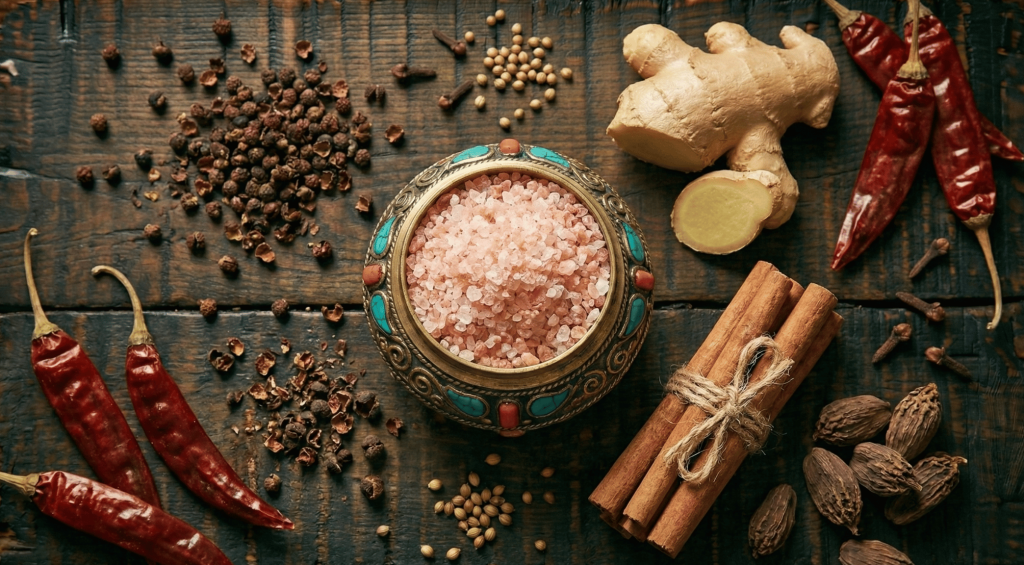
How Tibetan monks season momo filling: ginger, timur, coriander. The filling starts here. Timur is the wild Himalayan peppercorn, citrus-forward, lightly numbing, growing above 1,500 meters, distinct from anything else in this collection. Dumplings, stir-fries, noodles, roasted vegetables.
Year-round
$14 · 45g
སེ་པེན
SEPEN
wild
Chili crisp
Wild timur (yer ma)
Ladakhi dried chili
Cumin
Turmeric
Asafoetida
At Thikse and every monastery across Ladakh, sepen is on the table at every meal. Chili ground with timur, wild Himalayan pepper harvested once a year above 1,500 meters. Timur is citrus first, then a numbness that spreads slow. Asafoetida, ferula root and not allium, is the traditional Ladakhi substitute that binds the heat. Momos, thukpa, eggs, noodles, rice.
Year-round
$16 · 90ml
ខ្មែរ
Cambodian
រសជាតិ
Rosacheat · Taste
Where pepper is king.
ភ្នំ
PHNOM
peak
Table blend
Kampot black pepper (PGI)
Kampot white pepper (PGI)
Kampot red pepper (PGI)
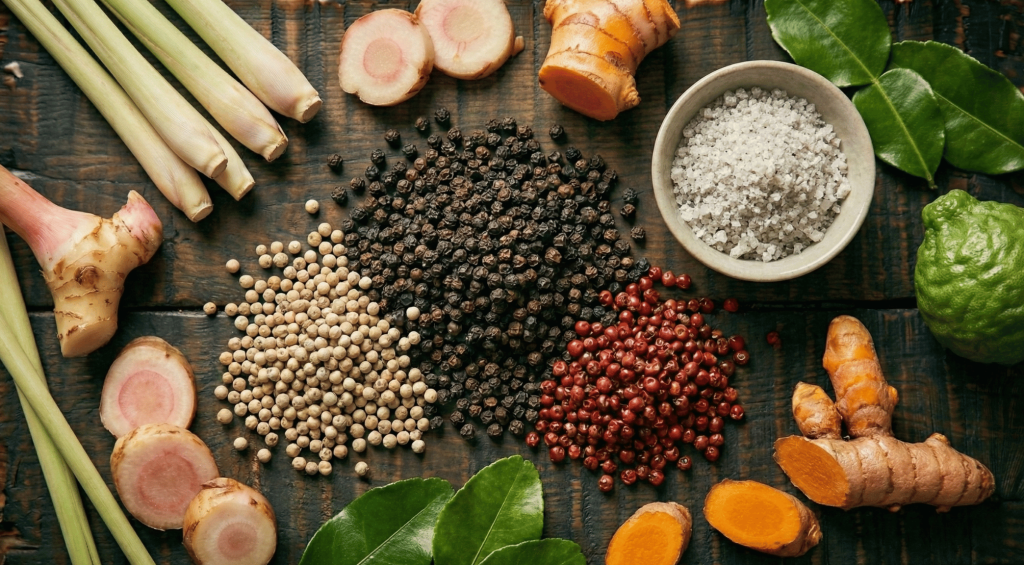
Three peppers from the same hills, picked at three different moments on the vine. Black, harvested early: earthy, floral, the sharpest finish. White, hulled and sun-dried: clean and direct, nothing in the way. Red, left until fully ripe: the sweetest, most aromatic, with the longest finish of the three. Kampot pepper carries protected geographic status, grown in one province, named nowhere else on earth. Nothing has been added. For everything that deserves it.
Year-round
$32 · 45g
ម្រេច
MRECH
pepper
Finishing blend
Kampot red pepper (PGI)
Kampot black pepper (PGI)
Kaffir lime leaf
Flaked sea salt
Dried galangal
Kampot red and black, the same PGI-protected pepper as Phnom, seasoned. Red picked late on the vine, black picked early. Kaffir lime lifts them. Galangal adds warmth underneath. Flaked salt finishes. Floral first, then kaffir lime brightness, then galangal warmth, then the long Kampot finish. For everything.
Year-round
$16 · 55g
PRACTICE
No garlic · No onion
No leek · No chive · No scallion
METHOD
Fermentation over combination
Time over addition